

Last weekend we went to see the Lowry exhibition at Tate Britain in London. Although I knew of Lowry’s work and had seen examples such as the ones used on stamps in 1967, I didn’t really know a lot about him or the majority of his work.
http://www.youtube.com/user/TheArtFundUK?v=HJ_gTI_xOkQ
video by the art fund (http://www.youtube.com/user/TheArtFundUK)
Laurence Stephen Lowry (1887-1976) was born in Lancashire and the majority of his work depicts the area in which he grew up and the areas of Lancashire, where he worked. His style is distinctive both its composition and in its portrayal of humans. These latter often referred to as “matchstalk men” or “matchstick men”. During much of his lifetime his work was regarded as naive and of little artistic consequence.
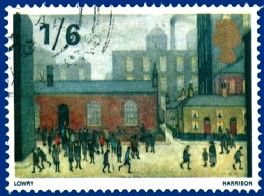
Upon leaving school, Lowry took up a job to rent collector as he walked the streets of the northern towns he saw the scenes which were to influence his choice of subject. A number of his pictures, for instance, depict evictions of tenants from rented housing. He was to continue working for the same company until his retirement in 1952.
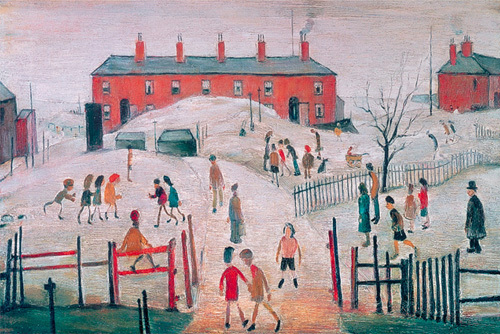
Major recognition of his contribution to British art did not really emerge until the 1950s. Larry died in February 1976, aged 88, and was buried in Manchester next to his parents. Lowry was by this time one of the most successful British artists and his pictures sold for millions of pounds. The Lowry, a gallery in Salford dedicated to his work, opened in 2000 and has a collection of over 50 of his paintings and over 200 drawings. Some of the works from the Lowry Gallery form a major part of the current exhibition at Tate Britain alongside works from private collections.
video by caerleonman (http://www.youtube.com/user/caerleonman?feature=watch)
“Matchstalk Men and Matchstalk Cats and Dogs” by Brain and Michael was a tribute to Lowry, who had died two years previously. For the song, Michael Coleman drew on his own memories of Salford and Ancoats as well as the paintings of Lowry.
I think the overriding impression I took away from the exhibition were of his dedication to record the events in scenes that he saw around him and to continue doing this, despite the lack of interest of people who saw the works. Lowry records an aspect of British life and history which was staunchly ignored by most artists of the period. The other thing that struck me was that’s whilst his early works show the industrial heartland in the raw. It is a place of activity and life, whereas in his later works. This seems to be a greater sense of dereliction and disuse, no doubt reflecting the changes that Lowry saw in the world around him.

 Pete's Favourite Things