

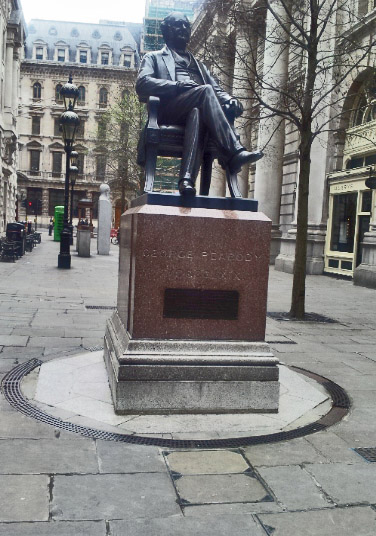
George Peabody was born in South Danvers, Massachusetts in 1795 to a poor family, one of seven children. At the age of 21 he moved to Baltimore, where he set up an import company, bringing dry goods from Britain. He became a successful businessman and financier and founded the Peabody Institute in Baltimore, the first of many around the USA, as an arts venue.
He visited London, on a number of occasions in connection with his import business and in 1837 he moved to London permanently, establishing a banking company.
George Peabody is best remembered for his numerous philanthropic ventures. Aside from the Peabody Institute’s and libraries which he founded in many US cities, he also founded the Peabody education fund at the end of the Civil War to enable ‘destitute children from the southern states’ to receive an education; the Peabody Museum of Archaeology at Harvard University and the Peabody Museum of Natural History at Yale University.
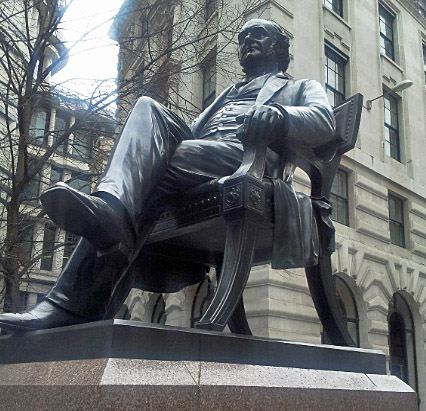
In the UK he is most remembered for the foundation of the Peabody trust, which sought to provide decent housing to the ‘Artisans and labouring poor of London’. This trust is still in existence and providing social housing to this day. Peabody was made a Freeman of the city of London; received the Congressional Gold medal and honorary doctorates from both Harvard University and Oxford University.
In 1868, the town of South Danvers was renamed Peabody.

George Peabody died in November 1869 and was buried in Westminster Abbey. However, his will requested that he be buried his hometown and so in February 1870 he was transferred by military ship to the US and re-interred in Massachusetts.
This statue,, which can be found at the rear of the Royal Exchange in London, is by W. W Storey, a fellow American, and was unveiled in 1871, just two years after his death.

 Pete's Favourite Things